

How Sunflower AI increases translation accuracy for Bible reading
Our new Bible verse display feature recognises when a speaker reads from the Bible, and shows the audience each verse from a published Bible in their own language instead of translating it on the fly. In our test, the Chinese verses reached the screen 2.2 seconds sooner, and 96.7% of the Chinese matched the Chinese Union Version, up from 67.1%.
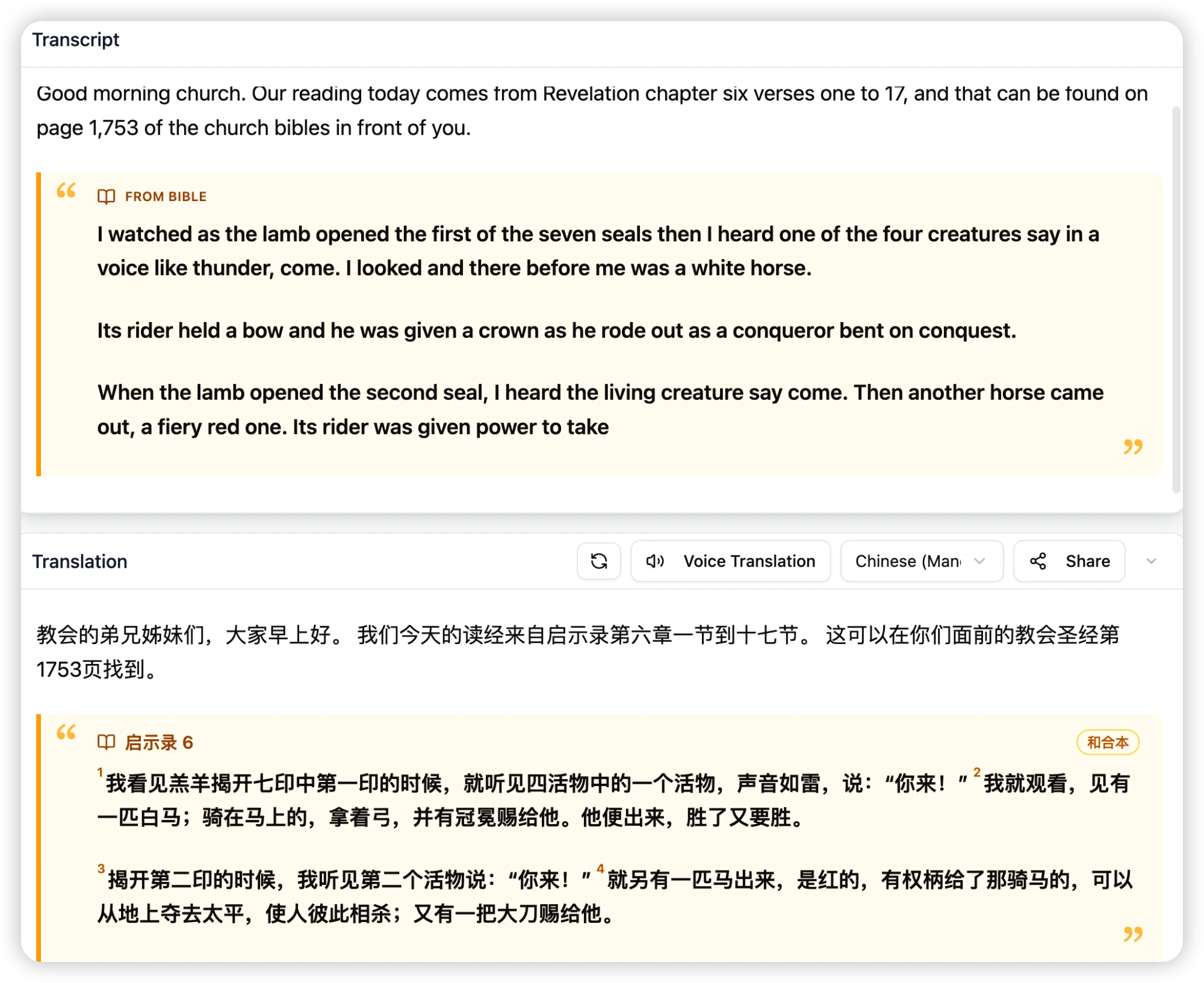
When a church reads from the Bible, many in the congregation know the words already, in their own language. A live translation that renders the reading afresh, sentence by sentence, gives them different words: a familiar verse comes out as an unfamiliar paraphrase, and a name can come out differently from the Bible they read at home.
Churches have been telling us this since our first trials. One church asked whether the translation could follow a specific Bible, such as the Chinese Union Version for Chinese. A congregation member wrote that Ziba, a figure from 2 Samuel, had come out in Chinese as 斑馬 (bānmǎ, “zebra”), and that Jonathan’s name switched between two Chinese forms in the same service. And a pastor passed on feedback from Nepali-speaking listeners: “God” was coming out as भगवान (bhagawān), a word they associate with Hindu worship, rather than परमेश्वर (parameshwar), the word in the Nepali Bible.
That’s why we built Bible verse display. Sunflower AI now recognises when a speaker reads from the Bible, and shows the audience each verse from a published Bible in their own language. We tested how much it improves a reading.
How Bible verse display works
When a speaker announces a passage (for example, “Our reading today comes from Revelation chapter 3, verses 1 to 22”), Sunflower AI recognises the reference. As the speaker reads, it matches their words to the verses, and shows each verse in the audience’s language from a published Bible: for Simplified Chinese, the Chinese Union Version (和合本 Héhéběn). The verses appear numbered, under the book and chapter, and marked as a Bible quotation, so readers can tell the reading from the rest of the sermon. Everything else the speaker says is translated live as usual.
Bible verse display currently works when the speaking language is English.
How we tested it
We read Revelation 3 (22 verses, NIV) twice in English, translated live into Simplified Chinese by Sunflower AI: once with Bible verse display on, and once with it off. We recorded when each line reached the audience screen and scored both runs the same way.
We measured two things:
- Time to first Chinese. For each verse, the time from the speaker’s first English words to the first Chinese on the audience screen (the median across the chapter).
- Match to the Chinese Union Version. How closely the Chinese on screen matches the Chinese Union Version (和合本 Héhéběn, Simplified), compared character by character across the whole chapter.
Results
| Bible verse display | On | Off |
|---|---|---|
| Time to first Chinese (median) (lower is better) | 3.2 s | 5.4 s |
| Match to the Chinese Union Version (higher is better) | 96.7% | 67.1% |
With Bible verse display off, about a third of the Chinese on screen differed from the Chinese Union Version: the live translation said the verses in its own words. With it on, almost every character matched, and each verse arrived 2.2 seconds sooner.
Watch the comparison
What this means for your church
With Bible verse display, Sunflower AI makes Bible readings both faster and far more accurate. Your congregation reads each verse as the speaker reads it, in the same words they know from their own Bibles.
You can see which Bible we use for each language.