

‘It’s so easy for them’: how Trinity Church Christchurch serves two ministries with one captions panel
Tim Wilson of Trinity Church Christchurch on what Sunflower AI is doing for his congregation — and what the 2023 census tells us about the linguistic shift unfolding across Aotearoa New Zealand.
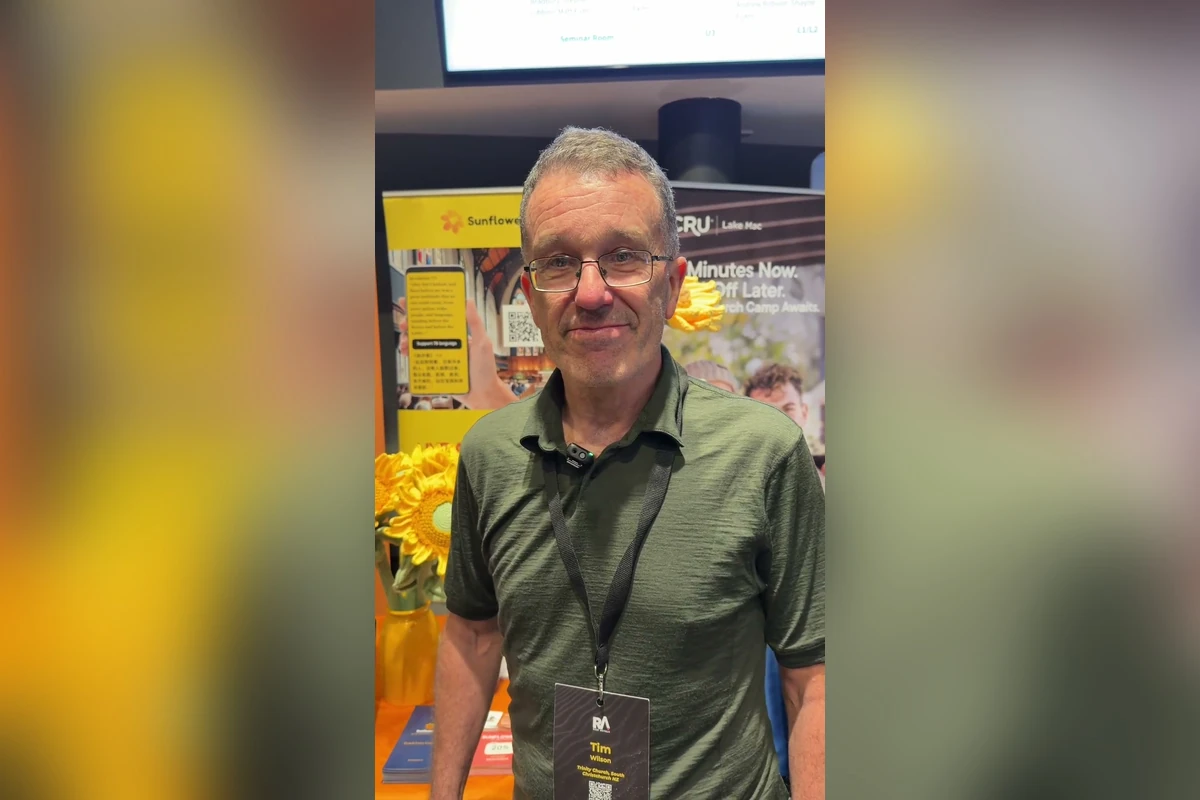
Our CEO Chuhao Liu is on the New South Wales Central Coast this week for Reach Australia’s national conference, and among the church leaders he sat down with today was Tim Wilson from Trinity Church in Christchurch — an evangelical Anglican parish on the south side of the city. Tim recorded a short testimony about what Sunflower AI has been doing for his congregation:
What’s striking about Tim’s testimony is how naturally he holds two use cases together in a single breath:
We love Sunflower AI, because we’ve been using it both for our hard-of-hearing in the service. They love following along with the service — it’s so easy for them. And it’s a great tool that welcomes people from lots of different cultures who suddenly can discover that the service is in their own language.

For Trinity, the same church captioning panel that lets a deaf member follow the sermon is also the panel that puts that sermon into Mandarin, Tagalog, or Korean for a visitor whose English is still a work in progress. One install at the AV desk; two ministries served. Tim also flagged something many of our church partners have warmed to recently:
They keep on making it better. You can load sermons up now, so it’s even more accurate in what it’s translating.
(That’s our sermon preload feature — you paste in the speaker’s notes or a draft script ahead of the service, and the transcription model uses it to lock onto proper nouns, Hebrew and Greek terms, place names, and any in-house theological vocabulary that would otherwise trip the recogniser.)
Why this matters in Aotearoa right now
Two big things are happening to New Zealand churches at the same time, and they pull in opposite directions.
The first is the well-known one: religious affiliation is shrinking fast. The 2023 census was the first in which more New Zealanders ticked “no religion” (51.6%) than any religion at all. Christians of all denominations are now 32.3% of the population, down from 36.5% in 2018. The Anglican Church in Aotearoa, New Zealand and Polynesia took one of the sharpest drops: 245,301 people identified as Anglican in 2023, about a 22% fall in five years. For a parish-based denomination whose self-understanding is to be present in every neighbourhood, that’s a deep, structural challenge.
The second thing is less remarked on. Over the same period the country has become unambiguously, audibly multilingual. More than 150 languages are now spoken across Aotearoa’s five million people, and Mandarin is comfortably the fourth-most-spoken language nationally. The various dialects of Chinese, taken together, form the second-largest language group after English.
In Christchurch specifically, the picture is this:
- The city now has 391,383 residents, up 6.1% since 2018 — growth driven primarily by inward migration.
- 28% of Christchurch residents were born overseas — the highest share in the city’s history.
- Of those overseas-born residents, 46% are from Asia and 21% from the United Kingdom and Ireland.
- 17% of the city identifies ethnically as Asian; 11% as Māori; 4.3% as Pasifika.
- Alongside English (spoken by 95.8%), the languages most commonly heard at home are Te Reo Māori, Samoan, and — inside the 16.8% “other languages” bucket — a long tail led by Mandarin, Tagalog, and Korean.
In other words, the same five years that saw Anglican identification fall by about a fifth also saw Christchurch gain more than 22,000 new residents, most of them from outside the English-speaking world. A parish in the city that wants to grow today is not reaching into a static market. It is reaching across a wider linguistic gap than it has ever had to bridge before.
Christchurch isn’t Auckland
Christchurch is not where the bulk of New Zealand’s non-English-speaking migration has settled — around 70% of the country’s Chinese and Korean populations live in Auckland. But the same Stats NZ release flags how broadly the country’s language mix is shifting: the Filipino community grew by nearly 50% between 2018 and 2023, Tagalog (up 37.5%) and Panjabi (up 45.1%) were among the country’s fastest-growing languages, and the growth is distributed across the main centres rather than concentrated in Auckland.
For a single parish, the practical observation is just this: when the speakers of a given language in your suburb number in the hundreds rather than the tens of thousands, a parallel-language service isn’t economically realistic. Making the one service you already run intelligible in those languages is.
What we’re hoping to see next
Trinity’s setup is already covering two ministries with one installation — accessibility for hard-of-hearing members and language accessibility for newcomers. The roadmap items Tim mentioned (sermon preload, translation accuracy improvements) are part of the same arc: we want every parish in Aotearoa to be able to say, on any given Sunday, that the service was understood by every person in the building, including the ones who didn’t grow up speaking English.
We’re grateful to Tim for taking the time at Reach to put it on record. If you’re a New Zealand pastor or AV lead reading this and wondering whether the maths works for your parish, the short video above is probably the most honest five-language answer we could give you. And if you want to talk specifics for your congregation, we’re a message away.